Rawalpindi Medical College, now Rawalpindi Medical University (RMU), has a proud history rooted in vision, dedication, and continuous growth. Established in Faisalabad on 18 March 1974 and shifted to Rawalpindi on 5 November 1974, the institution was founded under the leadership of Prof. Abdul Latif, who laid its foundations despite limited infrastructure. His efforts extended to developing hostels, staff residences, and major teaching hospitals, including Holy Family Hospital, Rawalpindi General Hospital (now Benazir Bhutto Hospital), and the District Headquarters Hospital, which became the first affiliated teaching hospital.
Successive principals strengthened RMU’s academic and clinical base by expanding teaching facilities, including a new teaching block at Holy Family Hospital, and by establishing key academic units such as the Department of Medical Education and the Institute of Allied Health Sciences. RMU also developed several state-of-the-art clinical centers, contributing significantly to advanced patient care and postgraduate training.
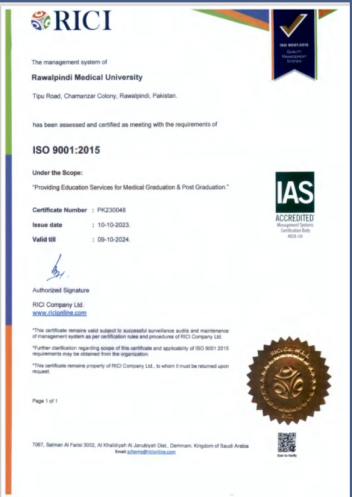
RMU has consistently produced high-achieving graduates who have excelled nationally and internationally. Its programs are accredited by CPSP and PMDC, with international recognition from bodies such as the GMC (UK), American Specialty Boards, and the World Health Organization. Reflecting its growing academic stature, RMU successfully hosted a major national academic conference in 2023, bringing together medical educators, clinicians, and researchers from across the country. Overall, RMU’s journey reflects a sustained commitment to excellence in medical education, research, and healthcare delivery.
Prof. Mohammad Umar, the first Rawalian Principal, focused on restructuring undergraduate training programs, enhancing student facilities, and even dedicating a beautiful park to Rawalians. He also played a role in facilitating a consensus on national guidelines for undergraduate medical training, reflecting RMU’s commitment to quality education.
RMU expanded its contributions to healthcare by establishing state-of-the-art centers such as the Center for Liver and Digestive Diseases, the Multi-Organ Failure Centre, the Medical ICU, the Department of Infectious Diseases, and the Department of Emergency and Critical Care. Over the years, RMU has consistently excelled in university examinations, and its graduates have made significant contributions to the medical field both nationally and internationally.
RMU’s academic programs are accredited by organizations like the CPSP and PMDC. The college has received recognition from international bodies, including the General Medical Council UK and American Specialty Boards. It has also fostered internship programs with various foreign universities and earned recognition from the World Health Organization (WHO).
In summary, Rawalpindi Medical University’s journey from its establishment in Faisalabad to its current status as a renowned medical institution in Rawalpindi is a testament to the dedication, hard work, and vision of its founding leadership and subsequent principals. RMU’s commitment to excellence in education, patient care, and international recognition has contributed significantly to the field of medicine and healthcare